Series

Folded Present

Time, held in layers

Acrylic face-mount (4 mm) on Dibond (4 mm)             Aluminum hanging frame                 Signed + Certificate of Authenticity

TIME? WHAT TIME?

Time held in layers. The image doesn’t rush forward. It gathers. It folds back into itself.
In this series I follow the feeling of the present as something thick—like light caught mid-turn, like a horizon that refuses to resolve. You’ll see mirroring, hinging, quiet repetition. Not as a trick. As a way of holding a moment open.
These works tend to reward distance first, then closeness. They’re calm. But they’re not passive.

About Folded Present

Folded Present treats time as something you can almost hold — then shows how quickly the hand dissolves.

Duration isn’t explained here; it’s felt as pressure, drift, return. The series moves between the measurable and the intimate: the clock’s promise of certainty versus the body’s knowledge that moments stretch, compress, and repeat.

The early works begin in motion — current turning into a veil, flow recorded as blur. Already a quiet argument that now is never cleanly cut from change.

From there the work folds inward. Spirals gather. A center appears. What read as movement becomes stillness that isn’t empty — the present thickening into substance rather than passing through.

Like clocks with their hands removed. Pure attention, suspended between before and after.


From the series: Folded Present

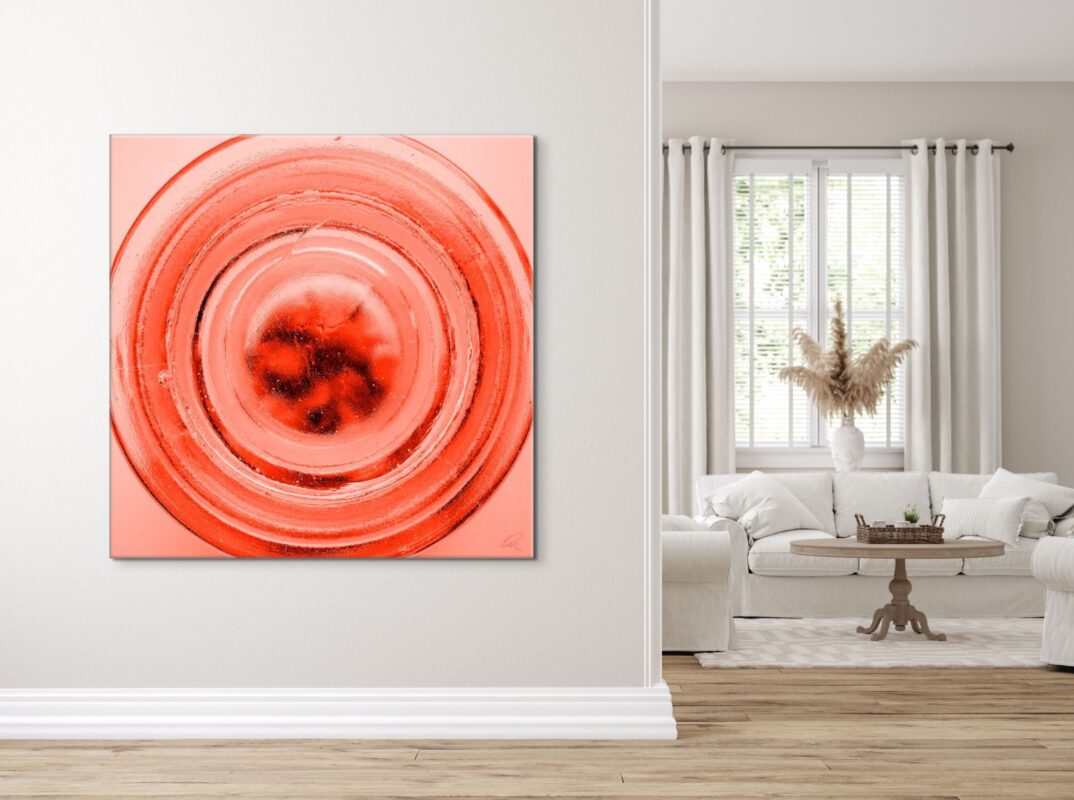
Held Breath

About Quiet Voltage

In Quiet Voltage, I kept returning to a simple fact: light leaves a trace.

These pieces begin in darkness. Not as mood, but as space—an open field where the smallest mark becomes audible. Against that black, the image arrives as a thin electric line: a loop, a tremor, a repeated arc that looks like writing without language. At first it can read like a signal—waveform, readout, pulse—but I’m not interested in data. I’m interested in presence: a current moving through space, recorded in one continuous breath.

What makes the voltage “quiet” isn’t the absence of energy. It’s the containment of it. Voltage is usually imagined as force, as impact. Here it becomes a held charge—steady, controlled, just beneath the surface. The marks are luminous, but they never turn loud. They don’t shout for attention. They drift, pulse, and settle.

The works move between two kinds of time. In some images, the trace stays readable: repeated loops, evenly spaced, like a measured oscillation. In others, the signal breaks open—particles scatter, a line smears, multiple exposures stack into a dense braid. I like that tension: clarity versus overload, a single gesture versus an accumulated field. You can sense the body behind it too—movement, hesitation, acceleration—translated into light.

Color does more than decorate here. The cyan and teal can feel like cold fire—clean at first, then unexpectedly tender. Deep blues carry distance and depth, like night held open. In a few works, the frame widens and the trace hovers over faint hints of a world. Even then, I try to keep the focus where it belongs: on the current itself, not on narrative.

For collectors, the work stays alive at different distances. Up close, you read line quality—micro-wobbles, thickness shifts, the blur where the signal speeds up. From across a room, it becomes a single floating event, almost sculptural. The black isn’t empty; it’s a stage.

Quiet voltage is the charge you can live with. A pulse that doesn’t demand you. It stays. It holds.

About Pressure Fields

In Pressure Fields, I’m not chasing “subjects.” I’m chasing conditions.

The series begins with air that feels almost weightless—deep blue opening into pale rays, clouds breaking like foam, a sky that reads as both distance and surface. But very quickly, the atmosphere thickens. What looks like weather becomes texture. What looks like landscape becomes matter. The images keep asking the same quiet question: What happens when energy leaves a visible trace?

 There’s a particular kind of blue here—cobalt pushed toward electric, then pulled back into shadow. It isn’t decorative. It functions like space. In the sky works, that space is literal: light fans outward, and the frame behaves like a window. In the branch canopy, the world turns into drawing—dark lines suspended against a luminous depth. It’s a moment of orientation, a reminder of scale. You feel your own body under the image, looking up.

Then the series starts to compress.

Cloud grain becomes something closer to particulate. A field of scattered light turns into a surface you can imagine touching. Water appears not as a scene, but as a plane under tension: a bright seam divides tones, as if motion has been sliced open and held still. These seam-lines matter. They’re not just composition; they’re evidence. They suggest a boundary where one state changes into another—air into water, water into heat, calm into pressure.

That’s where the mirrored works come in. They don’t read as tricks. They read as folds—as if the image has been bent along an axis by force. The symmetry becomes a kind of lens, a pressure point, a contained impact. It holds your gaze the way a storm center holds air: not with noise, but with pull.

When the palette shifts toward ember and iron-red, the temperature rises without changing the underlying grammar. The warm works aren’t a different series. They are the same idea under a different load. Bubbles, bloom, dark cores—these forms feel chemical and bodily at once, like heat moving through liquid, like pigment lifting through a membrane. The reds don’t “decorate” the frame; they occupy it. They radiate, but they also bruise. The work stays calm, even at its hottest. That restraint is what gives the intensity its dignity.

The choice of acrylic on Dibond fits the language of the images. The surface carries color with optical depth—clean edges, a crisp plane, and a sense that light is not merely depicted but stored. Without a frame, the works present themselves as objects: not windows into elsewhere, but presences in the room. The aluminum hanging system keeps that feeling precise and contemporary—nothing ornamental, nothing that interrupts the field.

Seen together, Pressure Fields becomes a single movement across states: breath → seam → core → release. The series doesn’t ask you to interpret. It asks you to notice—how light fractures, how air thickens, how heat gathers, how a surface can feel like weather. You don’t stand in front of these works to decode them.

You stand there to let your perception slow down.

And then, quietly, change temperature.

About Membrane Studies

In Membrane Studies, I kept returning to the idea of a membrane: a thin layer that separates and connects at the same time. Not a wall. Not a window. More like skin—something that holds a boundary, yet still lets light and atmosphere move through in controlled fragments.

The work begins with what I think of as liquid light. Light that doesn’t arrive as a hard source, but as something that seems to flow—soft, held, almost material. In these pieces, glow and shadow can sit inside the same surface. You start by reading it as a field, and then the details begin to rise: striations, tissue-like textures, fine threads and ripples. The images feel photographic, yet quietly unreal. They carry the authority of something captured, but they refuse a stable subject.

A membrane doesn’t reveal everything. It filters. That filtering is the emotional engine of the series. Some works feel almost transparent, as if your gaze could pass cleanly through them. Others thicken and compress. Edges gather density. An axis appears. The picture plane tightens until it feels like a cross-section—an inside briefly exposed.

When symmetry shows up, I don’t treat it as an effect. I treat it as a fold. A pressure applied to the image until it doubles back on itself. In those works, the surface feels more direct—almost confrontational. You meet the piece head-on, as if it’s looking back.

Across the series, I wanted a consistent psychological register: intimate, interior, slightly uncanny—beauty with pressure behind it. Color is never there to decorate. It holds temperature. Reds can move from heat to warning to tenderness. Blues cool the room and deepen the sense of distance. Greens and yellows feel reactive—alive—without turning illustrative. The work keeps its composure. It doesn’t narrate. It doesn’t explain. It holds the moment just before meaning resolves.


In a space—home, gallery, institutional context—Membrane Studies asks for time. From close range you read grain, filaments, seams. From distance the work becomes atmospheric; the membrane becomes a field. That’s where the series is strongest for me: when the image stops behaving like a picture and starts behaving like a presence—quiet, controlled, and slightly charged.

About Portals & Thresholds

Portals & Thresholds is less a series of images than a sequence of invitations. Each work stages a passage: not from one place to another, but from one state to another—attention loosening from the worn-out known and leaning toward what has no name yet. The pictures don’t illustrate a story. They hold the moment just before a decision, when the body still prefers familiarity, but the mind senses that familiarity has gone stale.

Visually, the series returns to a few archetypal structures: the ring, the double-ring, the flare, the corridor of light. A ring is the simplest possible portal—an aperture, an iris, an opening that is also a boundary. It doesn’t tell you what lies beyond; it only declares that “beyond” exists. In these works, the aperture often appears suspended in fields of saturated color, as if a doorway has been cut into pure atmosphere. The dark center reads as void, but it’s not nihilistic. It’s a usable emptiness: a space the viewer can step into with the imagination. What makes these portals convincing is their material friction. You can feel the surface working—grain, scratches, halftone skins, soft distortions, and optical noise. The threshold is never a clean line; it is a membrane with thickness, a place where perception catches and shivers. That sense of the old becoming a little boring—shows up as repetition and patina: patterns that once felt alive now reading as routine. The work doesn’t shame that condition. It simply reveals it, the way a mirror reveals fatigue. Then the series begins to double. The single aperture becomes binocular: paired circles that suggest witness, judgment, and awakening at once. Two openings imply a choice, but also a new organ of seeing—depth perception. At this point the portal is no longer only “out there.” It becomes internal: a crossing inside the viewer, where instincts, memory, and desire renegotiate their grip. The double forms can feel watchful, even tenderly confrontational—like the unknown looking back. The culminating light-works push the idea to its limit: the threshold becomes a bright breach, a blown-out center you can’t fully enter with the eyes. This is the heart of the series’ spiritual charge. The unknown is not presented as a fantasy landscape; it’s presented as intensity—too bright, too blank, too ungraspable for the mind to domesticate. And that is precisely the point. A true threshold cannot be controlled in advance. It has to be crossed without guarantees.

In that sense, Portals & Thresholds is a practice. It trains courage as a form of attention: the willingness to leave the over-familiar room, to stand in the doorway, and to move—while still not knowing what you will become on the other side.

About Folded Present

Folded Present treats time as something you can almost hold—then shows how quickly the hand dissolves. Across these works, duration isn’t explained; it’s felt as pressure, drift, return.

The series moves between the measurable and the intimate: the clock’s promise of certainty versus the body’s knowledge that moments stretch, compress, and repeat.

Water becomes the first teacher. In Voltage Field and Skin Frequency, current turns into a veil: the world is clearly moving, yet no single instant can be isolated. The image records flow as blur—already a quiet argument that “now” is never cleanly cut from change.

From there the work begins to “solve” time into thresholds of form. Broken Equilibrium reads like a rupture—an emerald passage punched through a red field, as if an ordinary surface tears and a deeper layer shows through. Sink follows with two ember-like discs: simple markers that feel cellular and cosmic at once, like clocks with their hands removed—pure attention points suspended between before and after.

The vortex works move into the core proposition: the present is folded. Suspension and Silent Wight behave like rotations you can’t fully trace—motion without one direction, like thought circling itself. Fold in Time deepens the spiral into something like an iris or groove: time as loop, not line, recurrence with variation. Held Breath is the counterweight—stillness that isn’t empty. Its rings hold a dense center, suggesting the “now” can thicken into substance.

Philosophically, you can read this as lived time—continuity rather than countable units—and as the old puzzle: we know what time is until we try to define it. The works also hold open the tension between “only the present is real” and the sense that past and future remain strangely present in us. And if there’s no universal now—only local perspectives—then these images are honest: each is a self-contained frame of becoming.

And if time doesn’t exist at all? Then the series becomes even more literal. It stops representing duration and starts revealing the mind’s interface with change: blur, repetition, centering—small edits by which experience becomes coherent. The Block of Now functions like a score for this interface, showing the present not as a place you arrive, but as the continual folding that makes “this” appear.